You have decided to pursue clinical embryology training. Now comes the harder part — figuring out which programme is actually worth your time and money, and which ones will hand you a certificate without giving you the skills to back it up.
Bangalore has become one of India’s most active centres for fertility medicine. There are genuine training opportunities here. There are also plenty of short-term programmes that look credible on paper but offer very little in terms of real clinical exposure. Knowing the difference before you enrol can save you months of frustration.
This post is a practical checklist — not marketing, not a ranking. Just the things you should actually verify before paying any fees.
A certificate tells you someone completed a programme. The skills tell you what the programme was actually worth.
1. Does the curriculum go beyond theory?
The most important question — and the one most prospectuses quietly avoid answering directly. Ask for a module breakdown. A clinical embryology programme that is preparing you for an IVF lab should explicitly cover:
Semen analysis and sperm preparation
WHO criteria, morphology assessment, density gradient centrifugation, IUI and ICSI prep. This is foundational — if it is missing or vague, the curriculum is incomplete.
Embryo grading — Day 3 and blastocyst
This is what embryologists spend a significant part of their working day doing. You need to understand the grading systems, what good morphology looks like, and why it matters for transfer decisions.
Cryopreservation and vitrification techniques
Both embryo and oocyte freezing. Modern IVF labs rely heavily on freeze-all protocols — this is not an optional module.
IVF laboratory protocols and quality systems
SOPs, chain of custody for gametes, QC documentation, and the systems that govern how a lab operates. Without this, you will struggle on day one of any real lab job.
Hands-on laboratory demonstrations
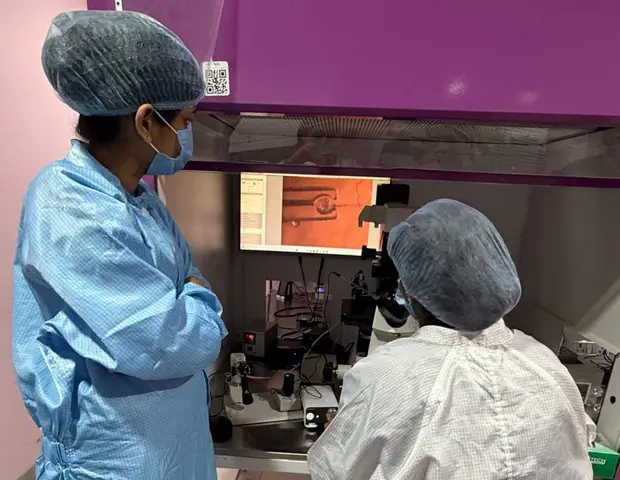
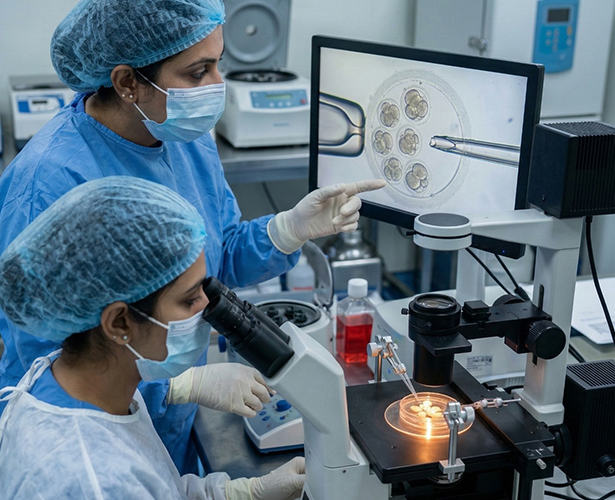
Not just watching videos. Actual guided demonstrations in a functioning lab environment — handling equipment, observing real workflows, and working through procedures with supervision.
If a programme’s course outline is a bullet list of vague topics without specifying what you will do in the lab, treat that as a signal to ask harder questions before committing.
2. Is there real lab access — or just video content?
This is the single biggest differentiator between a clinical training programme and an online certificate course dressed up to look like one. Embryology is a practical discipline. You can read about oocyte handling or vitrification protocols perfectly well from home. But unless you have stood at a laminar flow hood and actually worked through those procedures under supervision, the knowledge does not translate to competence.
Ask specifically: Is there access to a working IVF lab? How many hours of lab time are included? Are demonstrations live or recorded?
A blended learning model — where structured academic content is combined with in-person lab sessions — is the realistic minimum for a programme that will hold up when you are applying for jobs. Fully online embryology courses have their place for refreshing existing knowledge, but they are not a substitute for clinical training if you are entering the field fresh.
Worth asking
Request the schedule before you enrol. If lab sessions are not listed as specific sessions on specific days, they may not be as substantive as the brochure implies.
3. Who is actually teaching you?
Faculty credentials matter — but not in the way people usually think. The relevant question is not simply whether the trainer has a PhD or an MD. It is whether they have spent meaningful time inside an active IVF lab doing the work they are teaching. An academic who has published on embryo development but has not done a day of clinical embryology in ten years is a different kind of teacher than a practising embryologist with current clinical exposure.
Look for faculty who are — or have recently been — working fertility specialists, senior embryologists, or clinicians attached to functioning ART centres. Guidance from people who are still embedded in the field is qualitatively different from guidance from those who have stepped away from it.
4. What level of programme do you actually need?
Most institutes offer multiple programme levels. Choosing the right one for your current position matters — both financially and in terms of what you will get out of it.
| Programme level | Typical duration | Best for | What it should deliver |
|---|---|---|---|
| Executive Certificate | 2–3 months | MSc / Life Sciences graduates entering IVF labs for the first time | Foundational procedures: semen analysis, embryo grading, cryopreservation, lab protocols, QC basics |
| Advanced Diploma | 4–6 months | Working embryologists wanting to advance technically or move into lab leadership | Advanced procedures, QMS, lab audits, digital systems, automation, leadership skills |
| Fellowship | 1 year | Graduates seeking comprehensive clinical and research-level specialisation | Full clinical knowledge, infertility evaluation, advanced IVF lab, clinical coordination, reproductive medicine overview |
If you are a fresh MSc graduate, starting at fellowship level is not necessarily better than starting with a certificate — it depends entirely on what each programme includes and how much of it is practical. A well-structured 3-month certificate with genuine lab access will serve you better in your first job than a 1-year fellowship that is 80% classroom.
5. Red flags to watch for
Watch out for these
No specific lab schedule in the prospectus. If they cannot tell you in advance how many lab sessions are included and what each one covers, assume there are very few.
Certificate issued in days, not weeks. Clinical embryology cannot be meaningfully taught in a weekend workshop. Any “course” completing in under 4 weeks and granting a clinical certificate should be treated with scepticism.
Vague faculty credentials. If the website lists faculty titles without naming their clinical background or institutional affiliation, ask directly. Evasive answers tell you something.
Guaranteed placement promises. No training institute controls hiring. Institutes that guarantee job placement are often using it as a sales tactic. What matters is whether the training makes you genuinely competitive — placements follow from that, not the other way around.
No clarity on what “blended learning” means. The term is used loosely. Pin down the exact split between online modules and in-person lab time before you enrol.
6. Questions to ask before you commit
Go beyond the brochure. These are the questions that reveal whether a programme genuinely delivers what it claims:
01. Can you show me the detailed module breakdown — not the summary — including what is covered in lab sessions specifically?
02. How many hours of in-person lab training are included, and what is the student-to-trainer ratio during those sessions?
03. Who are the faculty members and what is their current clinical or professional background?
04. Is there a functioning IVF lab on-site, or are lab demonstrations done at a partner facility? Can I visit before enrolling?
05. What do recent graduates say about the programme? Can you connect me with someone who completed it in the last 12 months?
06. What is covered in the QC and lab protocols module — specifically?
07. Is there an assessment component, and what does it involve? (Theory-only exams suggest a theory-heavy programme.)
Why Bangalore specifically makes sense for this training
There is a practical reason to take your clinical embryology training in Bangalore rather than a smaller city. The concentration of fertility clinics, ART centres, and reproductive medicine specialists here is among the highest in India. That density matters because it creates access — to real clinical workflows, to practising faculty who are still embedded in the field, and to a network of professionals you will encounter again once you start working.
JP Nagar and the surrounding areas of South Bangalore in particular have seen significant growth in healthcare infrastructure. Institutes that are genuinely connected to this clinical ecosystem — rather than operating in isolation — offer a qualitatively different training environment.
How Khushi Research & Academics approaches this
At Khushi Research & Academics, the programmes are structured around the gap between academic knowledge and clinical readiness — which is exactly the gap that matters when you are trying to get hired.
The Executive Certificate in Applied Embryology & IVF Skill Development covers semen analysis, embryo grading, cryopreservation techniques, laboratory protocols, and quality systems — with structured modules and guided lab training sessions that give participants a practical understanding of real IVF lab workflows. Duration: 2–3 months, blended learning.
For experienced professionals, the Advanced Executive Diploma in IVF Technology, Automation & Lab Leadership builds on that foundation with advanced procedures, quality management systems, lab audits, and modern IVF technologies including digital lab management. Duration: 4–6 months.
The Fellowship in Clinical Embryology goes deeper still — a 1-year programme combining clinical knowledge with hands-on laboratory practice, infertility evaluation, and patient-centred reproductive care for those seeking specialised roles in fertility medicine.
Guidance from experienced fertility specialists and embryologists, exposure to real IVF clinical workflows, and learning supported by modern IVF technologies — not just slides and videos. That combination is what makes clinical training genuinely useful rather than merely certifiable.
Frequently asked questions
Explore programmes at Khushi Research & Academics
Certificate, diploma, and fellowship-level clinical embryology training in Bangalore — structured modules, hands-on IVF lab exposure, and guidance from practising specialists. For MSc and Life Sciences graduates ready to enter the field.View All Programmes →