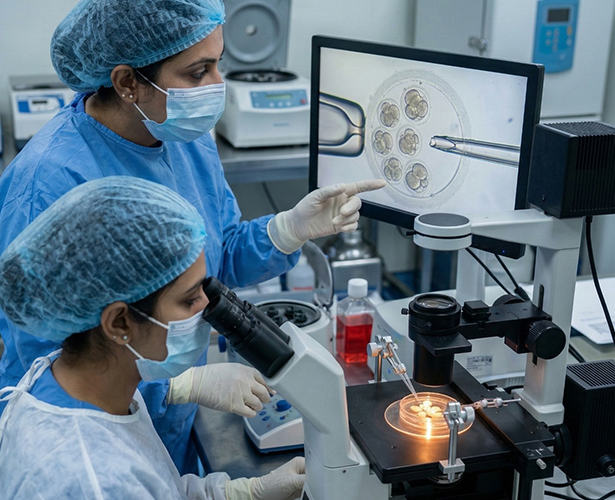
You have an MSc in Embryology — or maybe Biotechnology, Zoology, or Life Sciences — and you know the field you want to enter. IVF. Reproductive medicine. The lab side of fertility care. But between your degree and your first job, there is a gap that nobody in college really talks about: clinical exposure.
This post maps it out honestly. The roles that exist, what each one actually involves day-to-day, the skills IVF labs look for when they hire, and the training path that takes you from graduate to functioning clinical embryologist.
The MSc gives you the science. The lab gives you the career. The training in between is what makes you hireable.
The IVF industry in India — why now is a good time to enter
India has over 2,000 IVF clinics and that number is growing by 15–20% year on year. The demand for trained embryologists, andrologists, and fertility lab technicians consistently outpaces supply. Clinics in metros and tier-2 cities routinely struggle to find candidates who have both the academic background and hands-on lab experience.
If you have an MSc in a relevant science and you invest in clinical training, the field is genuinely open. The challenge is not competition — it is preparation.
The roles available after MSc Embryology
IVF labs are not a single job — they are a team of specialists, each with a defined function. Here are the core roles and what they involve:
Junior Embryologist
Assists with IVF procedures — egg collection, fertilisation, embryo culture, and embryo transfer preparation. This is the most common entry-level role for MSc graduates.
Andrology Technician
Handles semen analysis, sperm preparation (IUI and ICSI), and sperm banking. Often the first lab role available to new graduates as it requires fewer procedural prerequisites.
IVF Lab Coordinator
Bridges the clinical team and the lab — scheduling cycles, coordinating with patients, managing documentation. Ideal if you want a patient-facing role with lab knowledge.
Fertility Counsellor
Supports patients through the emotional and informational aspects of fertility treatment. Suits Life Sciences graduates with strong communication skills.
Senior Embryologist
Independently performs ICSI, embryo biopsy for PGT, and advanced cryopreservation. Typically requires 3–5 years of supervised clinical experience.
IVF Lab Manager
Oversees lab QC systems, SOPs, staff training, and regulatory compliance. Combines deep clinical knowledge with management and leadership skills.
What IVF labs actually look for when they hire
Hiring managers at fertility clinics are not primarily looking at your degree classification. They want to know what you can do on day one. Here is what that looks like, role by role:
| Role | Core technical skills needed | Soft skills / other |
|---|---|---|
| Junior Embryologist | Embryo grading (Day 3 and blastocyst), basic vitrification, egg handling, lab documentation | Attention to detail, steady hands, ability to work under pressure |
| Andrology Technician | Semen analysis (WHO criteria), sperm washing, density gradient, sperm morphology assessment | Patient communication, precision, confidentiality |
| Lab Coordinator | IVF cycle scheduling, EMR/LIS software, treatment protocol basics | Communication, empathy, multitasking |
| Senior Embryologist | ICSI, PGT biopsy, advanced cryopreservation, QC management, KPI tracking | Decision-making, mentoring junior staff, SOPs ownership |
| Lab Manager | QMS, lab audits, NABL/JCI compliance basics, digital lab systems | Leadership, vendor management, reporting to clinicians |
Notice the pattern. Every role — even the coordinator — requires you to understand IVF lab workflows from the inside. You cannot learn embryo grading or semen analysis parameters from a textbook alone. This is the gap that structured clinical training fills.
The realistic training path from graduate to embryologist
Here is how the progression typically looks for a Life Sciences or MSc Embryology graduate in India:
- Complete your MSc (you are here)
Embryology, Biotechnology, Zoology, Reproductive Biology, or a related Life Sciences discipline. This is your scientific foundation.
2. Enroll in a structured clinical embryology programme
A 2–3 month Executive Certificate or longer Fellowship in Applied Embryology gives you hands-on exposure to IVF lab procedures — semen analysis, embryo grading, cryopreservation, and lab QC. This is the step most graduates skip, and it is the reason good candidates do not get shortlisted.
3. Enter the lab as a Junior Embryologist or Andrology Technician
With clinical training on your CV, you become a realistic candidate. Most entry positions are in fertility clinics and hospital-based IVF centres in metro and tier-2 cities.
4. Build 3–5 years of supervised clinical experience
Develop proficiency in ICSI, advanced cryopreservation, and QC systems. This is the phase where your practical skills compound into real expertise.
5. Advance to Senior Embryologist or Lab Manager
At this stage, experienced professionals pursue advanced diplomas in IVF technology and lab leadership to formalise their management and systems skills.
What about salary? Is this worth it financially?
Honest numbers, because vague optimism is not useful:
Entry-level embryologists in India typically start between ₹2.5 – 4.5 LPA, with variation based on clinic type and city. Metros like Bangalore, Mumbai, and Delhi tend to pay higher. With 3–5 years of solid IVF lab experience and skills in ICSI or advanced cryopreservation, salaries in the ₹6 – 12 LPA band are realistic at established fertility centres. Lab managers and senior embryologists at premium clinics can go above this.
The field rewards skill accumulation. The faster you build genuine clinical competence, the faster you move up that band.
How Khushi Research & Academics fits into this path
The programmes at Khushi Research & Academics in Bangalore are built specifically for this transition point — the gap between your MSc and your first clinical role.
The Executive Certificate in Applied Embryology & IVF Skill Development (2–3 months, blended learning) covers the foundational procedures IVF labs expect on day one: semen analysis, embryo grading, cryopreservation techniques, laboratory protocols, and quality systems. It is designed for life science graduates and MSc holders who need structured clinical exposure before entering the workforce.
For those already working in fertility labs, the Advanced Executive Diploma in IVF Technology, Automation & Lab Leadership covers advanced procedures, QMS, lab audits, and the digital systems modern IVF centres now use. The Fellowship in Clinical Embryology (1 year) goes further still, combining clinical knowledge with laboratory practice for those seeking specialised roles in reproductive medicine.
The learning approach across all programmes combines structured modules with hands-on laboratory demonstrations and real IVF clinical workflow exposure — because that is the only kind of training that actually translates at work.
Frequently asked questions
Ready to take the next step?
Khushi Research & Academics offers structured clinical embryology programmes in Bangalore for MSc and Life Sciences graduates. Hands-on IVF lab training, experienced faculty, and a clear pathway into the field.Explore Our Programmes →